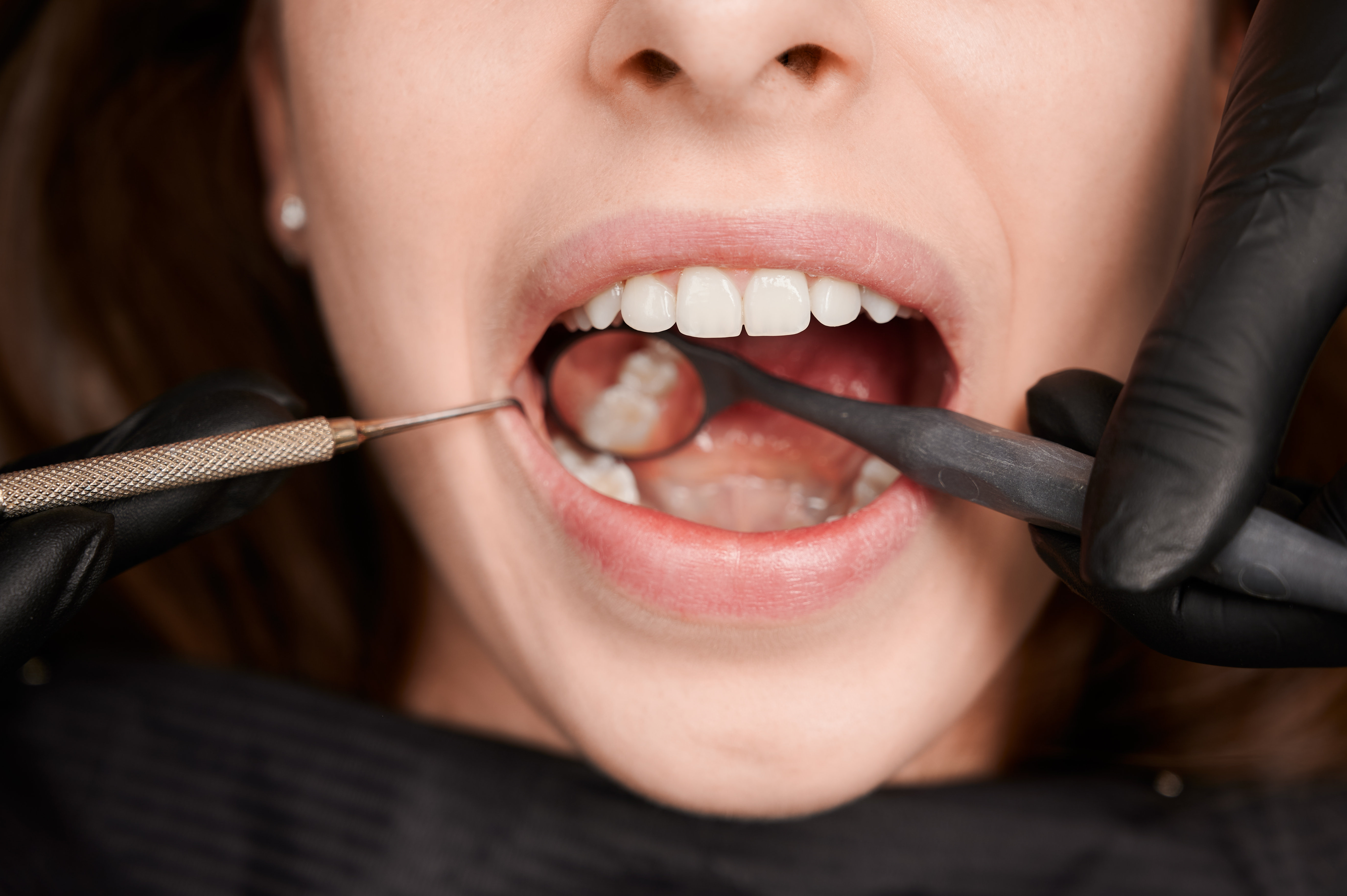

Whether a tooth needs a filling or a crown depends on how much healthy structure remains, not just the size of the cavity. Fillings suit small-to-moderate decay when plenty of tooth is intact; crowns are for teeth that are cracked, heavily decayed, worn, or have had a root canal. As a prosthodontist, the question I'm really answering in the chair isn't "how big is the hole." It's "will this tooth survive chewing for the next ten years" — and that reframing changes the answer more often than patients expect.
What actually decides it?
Two cavities can look almost identical on an X-ray and still lead to different treatments. That surprises people, but it's the heart of this whole decision. The size of the decay matters, yet what matters more is what's left once that decay is cleaned out — how much solid, healthy tooth remains to carry the load of chewing.
A dentist is weighing several things at once: how much structure survives after the decay is removed, whether the tooth is cracked, how much biting force that particular tooth has to absorb, and whether it's already been weakened by previous fillings or a root canal. A small cavity in a tooth that's otherwise solid is a filling, comfortably. A tooth that's lost much of its wall, or has a crack running through it, is a different conversation.
So the honest one-line answer is this: a filling rebuilds part of a tooth, while a crown wraps and protects the whole of it. Which one your tooth needs is a judgement about strength and survival, not a fixed rule you can read off a chart.
What a filling does (and when it's right)
A filling is the more conservative repair, and that's a genuine virtue. The dentist removes the decayed part of the tooth and rebuilds the space with a material — usually tooth-coloured composite resin, sometimes amalgam or glass ionomer — sealing it to keep bacteria out and restoring the tooth's shape and function. It's typically done in a single visit, under local anaesthetic.
Fillings are the right call when a good amount of healthy, strong tooth structure remains to support the repair. That covers most small and moderate cavities, minor chips, and early decay caught before it spreads. The big advantage is preservation: a filling keeps the maximum amount of your natural tooth, which is always the goal when it's safe to aim for it. You can read more about the procedure and materials on our dental filling page.
There's a catch worth understanding, though. Every filling removes a little tooth structure, and each repair leaves the tooth slightly less robust than before. A tooth that's been filled several times, or filled very large, can reach a point where adding yet another filling simply doesn't leave enough solid tooth to hold up. That's often the moment the conversation shifts toward a crown. And if a fresh filling sits slightly too tall, the tooth can feel odd when you bite — usually an easy adjustment, as our piece on why a tooth feels high after a filling explains.
What a crown does (and when you need one)
A crown is a custom-made cap that covers the entire visible tooth, like a helmet fitted over what remains. To place one, the dentist reshapes the tooth, takes an impression or digital scan, and fits a lab-made (or sometimes same-day milled) cap in porcelain, ceramic, porcelain-fused-to-metal, or zirconia. It usually takes one or two visits.
Because it surrounds and binds the whole tooth together, a crown is the right tool when strength is the priority. The clearest indications are:
- A large cavity or a big old filling that has left too little solid tooth to support another direct repair.
- A cracked tooth, where the crown holds the pieces together and stops the crack spreading under bite pressure.
- After a root canal, especially on back teeth, which turn brittle and fracture easily without full coverage.
- A heavily worn or broken tooth, rebuilt to restore shape and function.
- A tooth supporting a bridge, which needs full coverage to anchor it.
You can see the materials and process on our crowns and bridges page. Here's the quick side-by-side that captures the trade-offs.
| Consideration | Filling | Crown |
|---|---|---|
| Coverage | Repairs part of the tooth | Caps the whole tooth |
| Best for | Small to moderate decay, minor chips | Cracked, heavily decayed, worn, or root-treated teeth |
| Tooth structure | Preserves the most | Requires reshaping (removes more) |
| Visits | Usually 1 | 1–2 (or same-day milled) |
| Typical lifespan | Several years | 10–15 years or more |
| Upfront cost | Lower | Higher |
Want a second opinion on a crown recommendation?
A good dentist can explain exactly why your tooth needs full coverage rather than a filling. Use this guide to ask the right questions, then have a qualified dentist near you examine the tooth and the X-ray.
The "half the tooth" rule and cracked teeth
Is there a clean threshold where a filling becomes a crown? Not exactly — and any dentist who claims a precise percentage is overselling the science. But there's a useful rule of thumb many clinicians lean on: once roughly half or more of the tooth's chewing surface is gone to decay, fracture, or old filling, full coverage starts to look like the safer bet.
Think of a tooth a little like an eggshell. Intact, it's remarkably strong. Drill a small hole and it still holds together fine. But take away enough of the walls and what's left flexes and cracks under pressure it used to shrug off. A large filling can sit in a hollowed-out tooth looking perfectly fine, while the thin remaining walls quietly become a fracture waiting to happen.
Cracked teeth are their own category, and they're where this really bites. A crack flexes every time you chew, a bit like a chip in a windscreen that creeps wider over time. A filling placed over a crack doesn't stop that flexing — the crack can keep travelling around or beneath it. A crown clamps the whole tooth in a band, stopping the movement and protecting it from splitting completely. If you've had a sharp jolt of pain on biting that vanishes when you let go, that's a classic crack signal, and our guide on tooth pain when biting down is worth a read.
Why a crown after a root canal often matters
This is one of the few places where I'll be quite firm, because the evidence is strong and the stakes are a whole tooth. A root canal saves a tooth by removing its inflamed or infected pulp — but in doing so it also leaves the tooth drier and more brittle than before, with less internal structure. Back teeth, which take the heaviest chewing forces, are especially vulnerable afterwards.
The numbers make the case better than I can. A 2025 review in the British Dental Journal summarised studies showing that root-treated teeth restored with a crown had around 94% survival at five years and 89% at ten, while those left without a crown dropped to roughly 77% and 62%. In other reports, posterior teeth without a crown were several times more likely to need extraction within eight years. That's not a marginal difference — it's the gap between keeping a tooth and losing it.
This is why the crown is best thought of as the final step of root canal treatment, not an optional upsell afterwards. If you've recently had a root canal and you're weighing the restoration, our guide to the warning signs of infection after a root canal is a useful companion, since a well-sealed crown also helps keep reinfection out. Not every root-treated tooth needs full coverage — a front tooth with little damage may not — but for molars, it's usually the difference-maker.
The middle ground: inlays and onlays
The crown-or-filling framing leaves out a genuinely useful third option, and I think more patients should hear about it. Inlays and onlays — sometimes called partial crowns — sit neatly between the two. They're made in a lab (or milled chairside) as a solid, precisely fitting piece, then bonded into place.
The distinction is simple. An inlay fits within the cusps of the tooth, a bit like a stronger, custom-made filling. An onlay goes further, covering one or more cusps to reinforce them, without grinding the whole tooth down for a full crown. When a tooth needs more than a direct filling can safely give but doesn't yet warrant total coverage, an onlay can be the smart, tooth-sparing answer — preserving the healthy cusps a crown would sacrifice.
And they perform. Ceramic inlays show roughly 91–95% survival at ten years in the research, comparable to full crowns for similar cases, while keeping more of your natural tooth in reserve for whatever the future holds. The main reason you don't hear about them more is that they take more chairside skill and lab work than a filling — but for the right tooth, that conservatism pays off for decades.
Cost, longevity, and the "cheaper now" trap
Money is a fair thing to weigh, and I'd never pretend otherwise. A filling costs less upfront than a crown — under the NHS banding system, for instance, fillings fall into a lower-cost band than crowns. So the temptation to choose the cheaper repair is understandable.
But "what's cheapest today" is the wrong question. If a tooth genuinely needs a crown and gets a large filling instead, and that thin-walled tooth later fractures, you can end up paying for a crown anyway — or losing the tooth and facing the far greater cost of replacing it. The cheaper choice up front can quietly become the most expensive one.
The trap runs the other way too, and this is where I'll defend your wallet. Crowning a tooth that only needed a filling isn't harmless caution. The aggressive reshaping a crown requires removes healthy enamel that never grows back, can stress or even damage the nerve enough to trigger a root canal, and can make the gum-line edges trickier to keep clean. So be a little wary of blanket advice that every filled tooth needs a crown. The right answer balances durability against preservation — and a dentist who explains specifically why your tooth falls on one side of that line is the one worth trusting.
Myths about crowns and fillings
A few persistent beliefs lead people astray, so let's clear them up.
"A crowned tooth can't get a cavity."
The crown itself won't decay, but the natural tooth underneath — and especially the margin where crown meets tooth at the gumline — absolutely can. Crowns don't retire you from brushing and flossing; if anything, that margin needs attention.
"A bigger restoration is always safer."
Not so. Over-treating a tooth removes healthy structure you can never get back and brings its own risks. More coverage is better only when the tooth actually needs it. Conservative care, done well, is a feature, not a shortcut.
"A filling always saves money."
Only if it's the right call. A filling in a tooth that truly needed a crown can fail, fracture, and cost you far more in the end. The cheapest restoration is the one that suits the tooth — sometimes that's a filling, sometimes it isn't.
Preservation and protection, in balance
The crown-versus-filling decision isn't really a contest between two treatments. It's a single judgement about one tooth: how much of it is left, how hard it has to work, and what will keep it whole for the longest time. Lean conservative when the tooth can take it, reach for full coverage when it can't, and ask your dentist to show you which side of that line your tooth sits on. Done right, the goal is always the same — your own tooth, kept as long as it possibly can be.
Frequently asked questions
How do dentists decide between a filling and a crown?
Dentists weigh how much healthy tooth structure remains after the decay is removed, plus the fracture risk and chewing forces the tooth must handle. If plenty of strong tooth is left, a filling usually works. If the tooth is cracked, heavily decayed, or weakened, a crown protects it better.
Can a tooth that needs a crown just get a filling instead?
Sometimes, but it can be a false economy. If too much tooth is missing, a large filling may leave the tooth prone to cracking under chewing pressure. Should it then fracture, you could face a crown anyway or even lose the tooth, costing more than choosing the crown first.
Do I need a crown after a root canal?
Often yes, especially for back teeth. Root-treated molars and premolars become more brittle and are far more likely to fracture without full coverage. Research shows crowned root-treated teeth survive much better than those left with only a filling. Front teeth with little damage may sometimes be restored without a crown.
Is a crown better than a filling?
Neither is better in every case. A filling is the more conservative choice when enough healthy tooth remains, preserving natural structure. A crown is better when the tooth needs full protection. Over-treating a tooth that only needs a filling removes healthy enamel unnecessarily, so the right choice depends on the tooth.
What is an onlay, and when is it used?
An onlay is a lab-made restoration that covers one or more cusps of a tooth, sitting between a filling and a full crown. It reinforces a weakened tooth while preserving more natural structure than a crown. Onlays suit teeth that need more than a filling but don't yet warrant full coverage.
Does getting a crown or filling hurt?
Both are done under local anaesthetic, so the tooth is numb and you feel pressure rather than pain. Some mild sensitivity to hot and cold for a few days afterwards is normal and usually settles within a week or two. Lasting or severe pain should be checked by your dentist.
How long do fillings and crowns last?
Fillings often last several years, varying with size, location, and material. Crowns generally last longer, commonly ten to fifteen years or more with good care. Both depend on oral hygiene, your bite, and habits like grinding. A crowned tooth can still decay at the margin, so brushing and flossing remain essential.
Repairing a tooth the right way
The best restoration is the one that fits your tooth — sometimes a filling, sometimes a crown, sometimes an onlay in between. Learn the options, then see a qualified dentist near you for an in-person assessment.
References
- American Dental Association — restorative caries treatment guidance and patient resources on fillings and crowns. ada.org
- National Health Service (UK). "Dental treatments" (fillings, crowns, NHS cost bands). nhs.uk/live-well/healthy-teeth-and-gums/dental-treatments
- "Principles guiding the restoration of the root-filled tooth." British Dental Journal, 2025. (crown vs no-crown survival of root-treated teeth) nature.com/articles/s41415-025-8401-4
- Fedorowicz Z, et al. "Single crowns versus conventional fillings for the restoration of root-filled teeth." Cochrane Oral Health Review. cochranelibrary.com
- "Onlays/partial crowns versus full crowns in restoring posterior teeth: a systematic review and meta-analysis." (cuspal coverage and survival) PubMed Central, PMC9677648.
- Mayo Clinic and Cleveland Clinic — patient guidance on when a dental crown is recommended. mayoclinic.org · my.clevelandclinic.org

Dr. Uzair Ahmed
A prosthodontist with 12+ years of experience and an established name in restorative and prosthetic dentistry in Lahore. PMDC-registered, with FCPS specialisation from CMH Lahore Medical College.
View full profile →
Dr. Sarwar Naseer
A capable young dentist known for gentle, painless treatment and aesthetic dentistry. PMDC-registered, trained at Akhtar Saeed Medical & Dental College, and focused on comfortable patient care.
View full profile →