Dental veneers are thin, custom-made shells — usually porcelain or composite resin — bonded to the front of your teeth to improve their colour, shape, and alignment. Getting them typically takes two visits over one to two weeks: one to prepare the teeth and take an impression, and one to bond the finished veneers in place. As a prosthodontist, I'll say upfront that the part most people underestimate isn't the procedure. It's that conventional veneers permanently change the tooth underneath — which is exactly why the planning matters as much as the placement.
What are dental veneers?
Think of a veneer as a wafer-thin facing for the front of a tooth — the NHS describes it as a little like applying a false fingernail. It doesn't replace the tooth or wrap around it the way a crown does; it resurfaces the visible side to change how the tooth looks.
Veneers are mostly a cosmetic tool, and a versatile one. They can lighten teeth that won't respond to whitening, close small gaps, reshape chips or uneven edges, and bring a slightly crooked smile into line. What they don't do is strengthen or repair the underlying tooth — that's an important distinction, and it's why veneers are usually a private, elective treatment rather than something done purely for dental health.
There are a few main types, and they shape the whole process. Conventional porcelain veneers are made in a dental lab and need a thin layer of enamel removed first. Composite veneers are built up directly on the tooth from tooth-coloured resin in a single sitting. And ultra-thin "no-prep" veneers remove little or no enamel at all. If your goal is mainly to brighten your smile, by the way, it's worth comparing veneers against simpler options like professional teeth whitening first — veneers are a bigger commitment than many people realise.
The veneers process, step by step
Here's how a conventional porcelain veneer case actually unfolds in practice. The same skeleton applies whether you're treating one tooth or a whole smile.
- Consultation and planning. The dentist examines your teeth and gums, takes X-rays and photos, and talks through what you want to change. Any decay, gum issues, or whitening is sorted first — veneers go onto a healthy, stable foundation, never over problems.
- The smile preview (wax-up or mock-up). This is the step I'd never skip. A trial design — built in wax on a model, or temporarily placed in your mouth — lets you see and feel the proposed shape and length before anything irreversible happens. It's your chance to say "longer," "less gummy," or "not that white" while changes are still free.
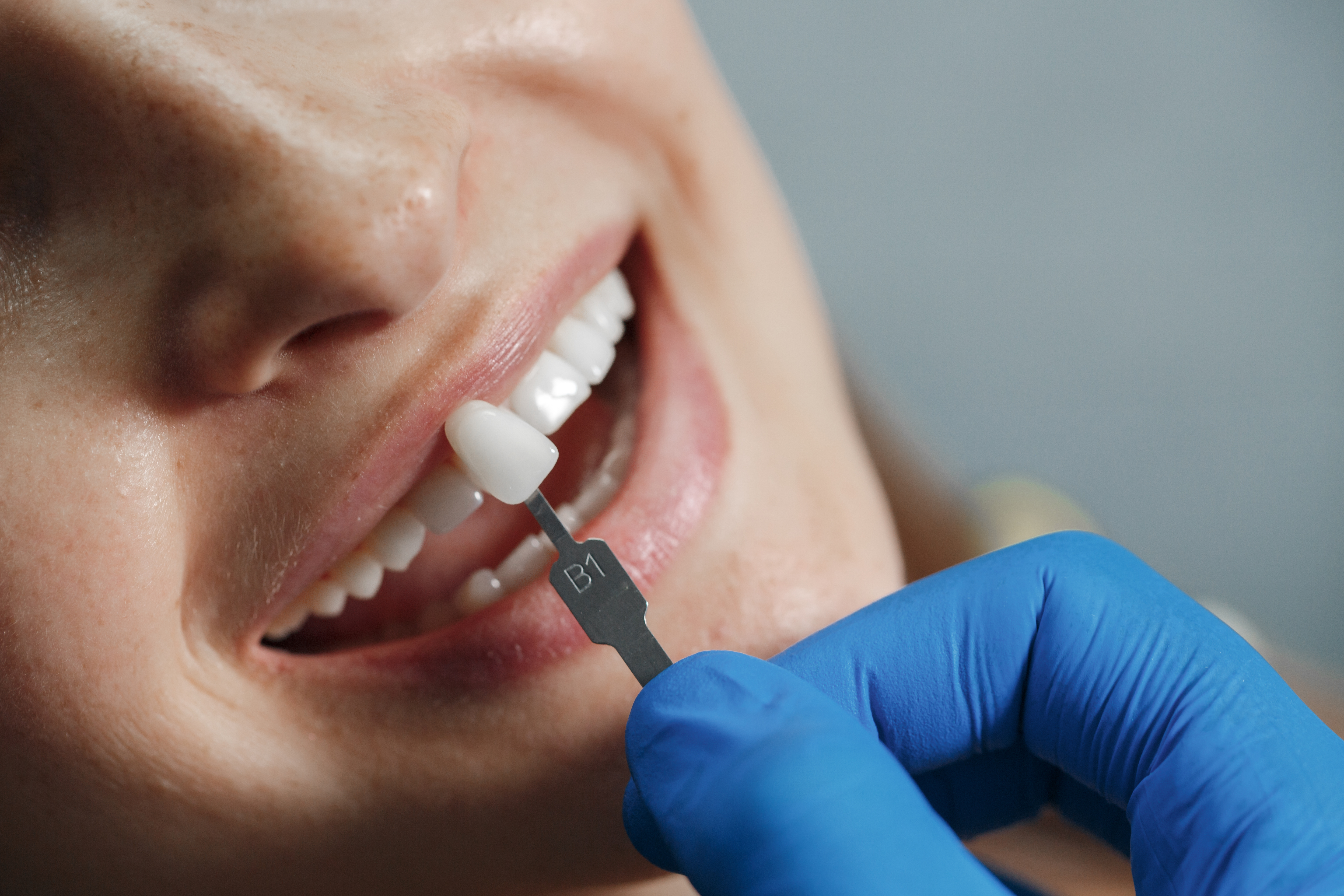
- Shade selection. You and the dentist agree on the colour, matched to the look you're after and your other teeth.
- Tooth preparation. A small amount of enamel — often around half a millimetre — is gently removed from the front of each tooth to make room for the veneer, usually under local anaesthetic.
- Impression or digital scan. A precise mould or 3D scan captures the prepared teeth and is sent to the lab as the blueprint for your veneers.
- Temporary veneers. Thin temporaries protect the prepared teeth and let you test-drive the new look while the lab works, usually over one to two weeks.
- Bonding. At the second visit, the temporaries come off, the veneers are tried in, then chemically bonded to the teeth with dental cement and set with a curing light. The dentist checks your bite, polishes the edges, and you're done.
Composite veneers compress this into a single appointment — the resin is sculpted onto the tooth and light-cured layer by layer, with no lab and often no temporaries. Some clinics with in-house milling can also produce porcelain veneers in one day, though the two-visit lab route remains the standard for most cases.
Porcelain vs composite vs no-prep
The "best" veneer depends entirely on what you're trying to achieve and how much you're willing to spend and remove. Each type trades off differently, so here's an honest side-by-side. (We'll do a deeper porcelain-versus-composite comparison in a future guide; this is the quick map.)
| Feature | Porcelain | Composite | No-prep |
|---|---|---|---|
| Visits | Usually 2 | Often 1 | Usually 1–2 |
| Enamel removed | Thin layer (~0.5 mm) | Little to minimal | Little or none |
| Typical lifespan | 10–15 years | 5–7 years | Varies; conservative |
| Stain resistance | Excellent | Lower (can discolour) | Good (porcelain) |
| Repairability | Replace if damaged | Often repairable chairside | Replace if damaged |
| Reversibility | Not reversible | More conservative | Most conservative |
In short: porcelain for the most natural, longest-lasting result; composite for a quicker, lower-cost, more repairable option; no-prep when preserving enamel matters most and the case is straightforward. No-prep isn't a fit for every situation — it struggles with heavily discoloured or significantly misaligned teeth — but when it suits, it's the kindest to your natural tooth.
Does getting veneers hurt?
For most people, the process is genuinely comfortable. When enamel is removed for porcelain veneers, it's done under local anaesthetic, so you don't feel the preparation itself. No-prep and composite veneers often need no anaesthetic at all, because little or no tooth structure is touched.
Afterwards, some mild sensitivity to hot and cold is common, especially while temporaries are in place, since a little of the enamel's natural insulation has been removed. It usually settles once the final veneers are bonded. If you already know your teeth run sensitive, it's worth mentioning at the consultation — our explainer on sharp versus lingering tooth sensitivity helps you describe exactly what you're feeling, which guides how we manage it. Lasting or severe pain after veneers isn't typical, and it's always worth flagging rather than waiting out.
Exploring whether veneers are right for you?
A smile preview and a proper assessment matter more than the procedure itself. Learn how veneers work, then see a qualified cosmetic dentist near you to plan the result before any enamel is touched.
The honest truth about irreversibility
This is the part of the conversation I care about most, and the one too many veneer adverts skip. With conventional veneers, a thin layer of enamel is permanently removed — and enamel doesn't grow back. That means once those teeth have been prepared, they will always need a veneer, crown, or other covering. There's no going back to the original tooth.
That isn't a reason to avoid veneers. It's a reason to go in with your eyes open. The enamel removed is small, the result can be beautiful and durable, and millions of people are delighted with theirs. But it's a genuinely permanent decision dressed up as a cosmetic one, and it deserves the same care you'd give any irreversible choice. Is a smaller change — whitening, a little bonding, or straightening — enough to get you most of the way there? Sometimes the answer is yes, and a good dentist will say so.
This is also why no-prep veneers exist and why I like them for the right case: they remove little or no enamel, keeping more of your natural tooth and far more of your options. They can't solve every problem, but when they fit, they're the more conservative path.
Are you a good candidate?
Veneers reward the right starting point. The foundation has to be healthy first: active decay or gum disease needs treating before any veneer goes on, because bonding to an unhealthy mouth is building on sand. If your gums flare or bleed, that's worth sorting first — our piece on gum pain when the tooth looks fine explains why gum health underpins everything else.
Veneers also aren't the right tool for every job, and an honest dentist will steer you elsewhere when something else fits better:
- Heavily damaged or weakened teeth often do better with a crown, which protects the whole tooth rather than just its face.
- Significantly crooked or crowded teeth are usually better aligned with braces or clear aligners than masked with veneers.
- Minor chips or small gaps can sometimes be fixed with simple composite bonding at a fraction of the cost and tooth removal.
- Heavy grinders can crack veneers, so a habit of clenching or grinding needs a plan — typically a night guard — built into the treatment.
Would you be happy with a slightly smaller change that keeps more of your own tooth? That's always worth asking before committing to veneers.
How long veneers last (and how to help them)
Porcelain veneers have an excellent track record. A systematic review pooling 25 studies and 6,500 veneers put their cumulative survival at around 95% at ten years, and in everyday terms they commonly last 10 to 15 years, sometimes longer. Composite veneers generally last about 5 to 7 years and are more prone to staining and wear, though they're easier and cheaper to repair or refresh.
How long yours last is partly down to you. A few habits make a real difference:
- Brush twice daily with a non-abrasive toothpaste and floss as normal — veneers don't get cavities, but the tooth at the margin still can.
- Don't use your teeth as tools, and avoid biting very hard things like ice or pen lids.
- Wear a night guard if you grind, and a mouthguard for contact sports.
- Keep up regular check-ups and professional cleanings so any issue is caught early.
One practical heads-up worth knowing in advance: whitening won't change a veneer's colour later, so the shade is essentially locked in at fabrication. If you want a brighter smile overall, whiten your natural teeth first, then match the veneers to that. It's a small detail that saves real regret down the line.
Common myths about veneers
A few stubborn beliefs send people the wrong way, so let's clear them up.
"Veneers rot the teeth underneath."
Not when they're well made and looked after. The tooth beneath a good veneer stays healthy with normal brushing, flossing, and check-ups. Problems trace back to poor hygiene or a poorly fitted veneer, not to veneers as a concept. That said — the enamel removal is permanent, and that part is true.
"You can just take veneers off and go back to normal."
With conventional veneers, no. Because enamel was removed, those teeth will always need a covering of some kind. Only no-prep veneers keep that door open.
"Veneers are indestructible and last forever."
They're durable, not invincible. Veneers can chip, debond, or wear, and they will eventually need replacing — porcelain typically after 10 to 15 years, composite sooner. Treating them as bulletproof is how they get broken.
Worth it — with eyes open
Veneers can do something genuinely transformative: hand someone back a smile they're happy to show. The procedure is comfortable, the results can last well over a decade, and the science behind them is solid. The one thing I'd send you away with is this — see your preview, weigh the gentler alternatives, and understand what's permanent before any enamel comes off. Get that part right, and the rest tends to take care of itself.
Frequently asked questions
How many appointments do veneers take?
Conventional porcelain veneers usually take two appointments, around one to two weeks apart: one to prepare the teeth and take an impression, and one to bond the finished veneers. Composite veneers are often completed in a single visit, since they're sculpted directly onto the teeth rather than made in a lab.
Do veneers hurt?
Getting veneers is usually comfortable. For porcelain veneers, the small amount of enamel removed is done under local anaesthetic, so you don't feel it. Some mild, temporary sensitivity to hot and cold afterwards is normal while temporaries are on. No-prep and composite veneers often need no anaesthetic at all.
Are veneers permanent or can they be reversed?
Conventional veneers are not reversible. Because a thin layer of enamel is removed to fit them, and enamel doesn't grow back, those teeth will always need a veneer or other covering. No-prep veneers, which remove little or no enamel, are the more conservative and potentially reversible option.
How long do veneers last?
Porcelain veneers commonly last 10 to 15 years, and research puts their cumulative survival at around 95% at ten years. Composite veneers tend to last about 5 to 7 years and stain more easily. Good hygiene, avoiding hard objects, and wearing a night guard if you grind all extend their life.
Do veneers ruin your teeth?
Veneers don't ruin teeth when they're well made and well cared for, but they do permanently alter conventional-prep teeth by removing enamel. The tooth underneath stays healthy with good brushing, flossing, and regular check-ups. Problems usually come from poor maintenance or grinding, not the veneer itself.
Porcelain or composite veneers — which is better?
Neither is simply better; they suit different goals. Porcelain lasts longer, resists staining, and looks more natural, but costs more and usually needs lab fabrication. Composite is cheaper, often done in one visit, and easier to repair, but wears and stains sooner. Your dentist can advise which fits your case.
Can you whiten veneers?
No. Whitening products and treatments don't change the colour of porcelain or composite veneers, because the shade is set when the veneer is made. If you want whiter teeth overall, it's best to whiten your natural teeth first, then match the veneer shade to the result you want.
Compare your smile options first
Veneers, whitening, bonding, or aligners — the right choice depends on your teeth and your goals. Read up, then see a qualified dentist near you to find the most conservative route to the result you want.
References
- National Health Service (UK). "Dental treatments" (veneers, whitening, crowns). nhs.uk/live-well/healthy-teeth-and-gums/dental-treatments
- Alenezi A, Alsweed M, Alsidrani S, Chrcanovic BR. "Long-Term Survival and Complication Rates of Porcelain Laminate Veneers in Clinical Studies: A Systematic Review." Journal of Clinical Medicine, 2021;10(5):1074. (10-year cumulative survival ~95.5%)
- Layton DM, Clarke M, Walton TR. "A systematic review and meta-analysis of the survival of feldspathic porcelain veneers over 5 and 10 years." International Journal of Prosthodontics, 2012;25(6):590–603.
- American Dental Association — patient resources on veneers and cosmetic dentistry. ada.org
- Journal of Prosthetic Dentistry — clinical literature on laminate veneer preparation and bonding. journals.elsevier.com

Dr. Uzair Ahmed
A prosthodontist with 12+ years of experience and an established name in restorative and prosthetic dentistry in Lahore. PMDC-registered, with FCPS specialisation from CMH Lahore Medical College.
View full profile →
Dr. Sarwar Naseer
A capable young dentist known for gentle, painless treatment and aesthetic dentistry. PMDC-registered, trained at Akhtar Saeed Medical & Dental College, and focused on comfortable patient care.
View full profile →